With a strong classical theatrical tradition, the United Kingdom is a breeding ground for creative research. What could be more natural than for the Royal Shakespeare Company to open up new fields of expression, between new media, new audiences and immersive innovations?
We met with Sarah Ellis, Director of Digital Development at the Royal Shakespeare Company, on the occasion of their latest “online” play, DREAM.
DREAM, “a live, online performance set in a virtual midsummer forest”, takes place from March 12 to 20 – with a special SXSW event included! More infos.
Adapting DREAM for an online audience
Sarah Ellis – My role at the Royal Shakespeare Company is to bring new artistic partnerships and collaborations, to explore the future of theater. Today we are working on the Audience of the Future project, which is a government funded project from UKRI (link), which is dedicated to research and innovation. We’re working with a selection of artistic partners, research partners and technology companies to research the future of live performance – with immersive technologies. And it’s been such a journey the last months! We were supposed to do a performance last June – and obviously had to stop production due to the Covid situation. We’ve had to completely rethink and reimagine DREAM for our online audience. And in that moment, we had to grieve a performance that we couldn’t do.
S. E. – We commissioned some audience research to find out how audiences were and what they wanted. It was overwhelmingly clear that our performances will bring people together – same as in real life. But within that, it also highlights a huge digital inequality. A lot of this technology is not in the hands of many people. We have to think about the accessibility and inclusiveness of what we create. Therefore we’ve made this particular piece (DREAM) at this moment in time to be available on desktop and mobile devices. We hope it might be something we can perform in the future for VR headsets. For now it was much more important to show the possibilities of DREAM to a wider audience – to bring them with us as we move forward.
Working on collaborative experience (in production)
S. E. – We’re bringing together all this expertise, all these great people to highlight different ways of working, different specialisms. This is a piece of research and development predominantly – and should be seen as that. There is huge experimentation and risk taking in it. We’re hoping to hear back from our audience, what works for them. Robert McNicholas from Marshmallow Laser Feast leads the creative team – with Sarah Perry, Movement Director and Pippa Hill, our Dramaturg. And that’s been a wonderful collaboration. I’ve seen such respect, learning and understanding looking at our story and world-building – how we embody that through physicality. We’re also working with the Philharmonia who worked with a complete range of tools and technologies to produce an interactive soundtrack for the piece.
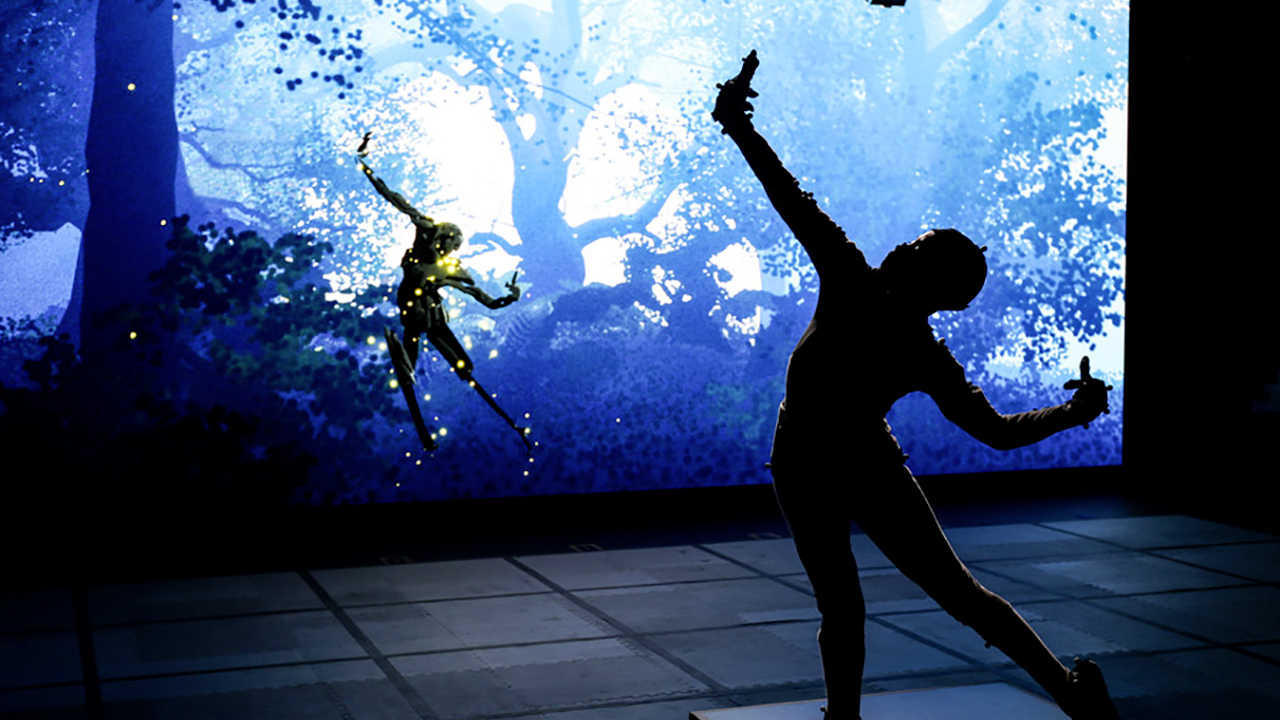
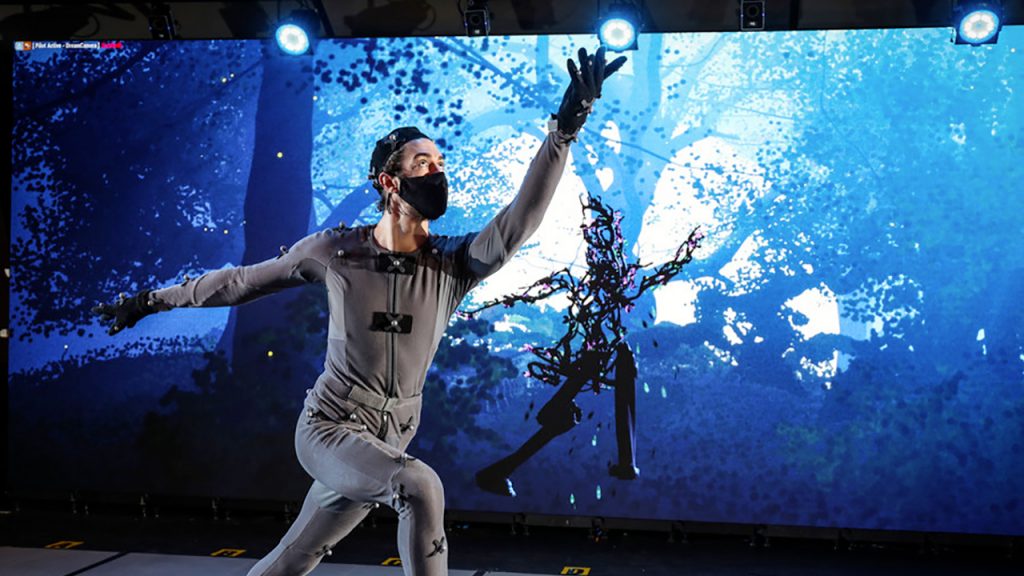
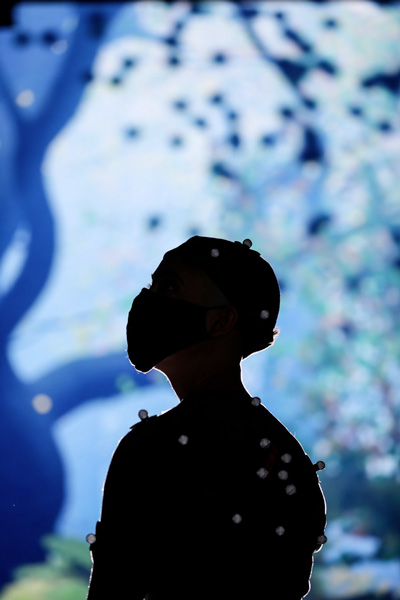
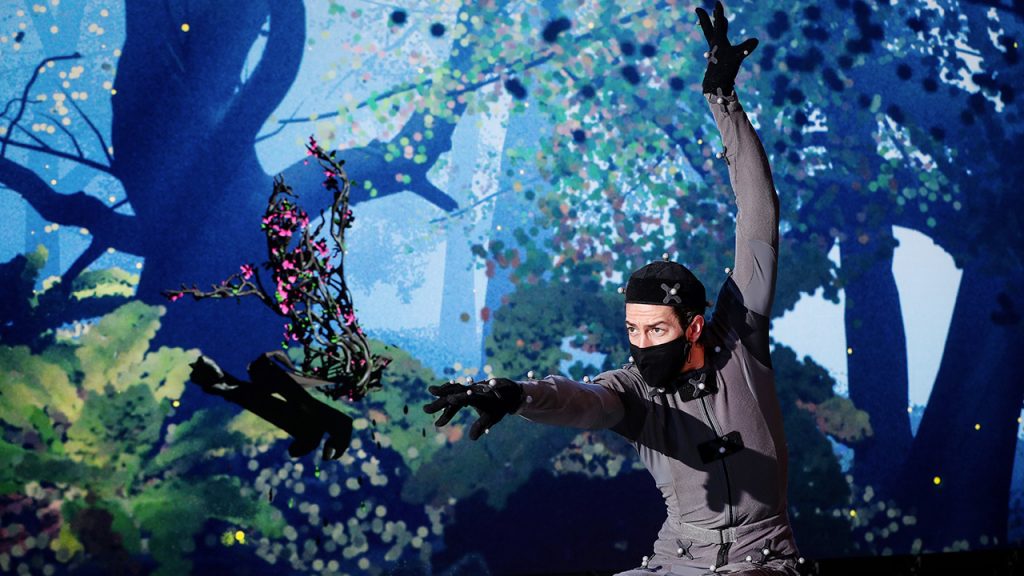
S. E. – DREAM is inspired by A Midsummer Night’s Dream by William Shakespeare. The experience is about half an hour long. We’re testing real-time motion capture, using environments and characters all created in the Unreal Engine. We created a pop-up covid-safe motion capture studio in Portsmouth for this. We’re using traditional show control as well, lighting and sound, converging map and spatial audio. One point is we’re also trying to find ways to create a connection between our audience and our performers. Because that’s what this is about effectively! Creating this during a pandemic was really hard, and in itself it is a celebration into something so experimental, generous and risk taking with an amazing team!
About DREAM, live performance
S. E. – We’re using real-time technologies. Latency and connectivity need to be our friends. We are part of a great community that is exploring how people can connect remotely and how we find those connections. We will learn new rituals, new mechanics around relationships with audiences. This is a research and development effort to find that out. We’ll have quite a big questionnaire at the end of the show for us to learn from that. All those learnings will be shared at the end, in the spirit of what this work is about. This is a statement of intent: asking big questions. It’s not putting a rubber stamp going “This is what we think”. We are showing you a world of possibilities. After that, what works for you? How could others take that forward? What can we learn and share about the technologies that we’ve used?
S. E. – There are about 100 tests of learnings behind-the-scenes. Audience research is our end goal to understand online distribution and to find genuine connections in a large scale audience. Because we have to look at a commercial model at the end, to find ways of making this work commercially. It is still a phase where a lot of this technology is incredibly expensive. Also the expertise is very limited. We have to democratize that a little bit! And to find ways to make everything more accessible, building the skills and craft person shape as we move forward.
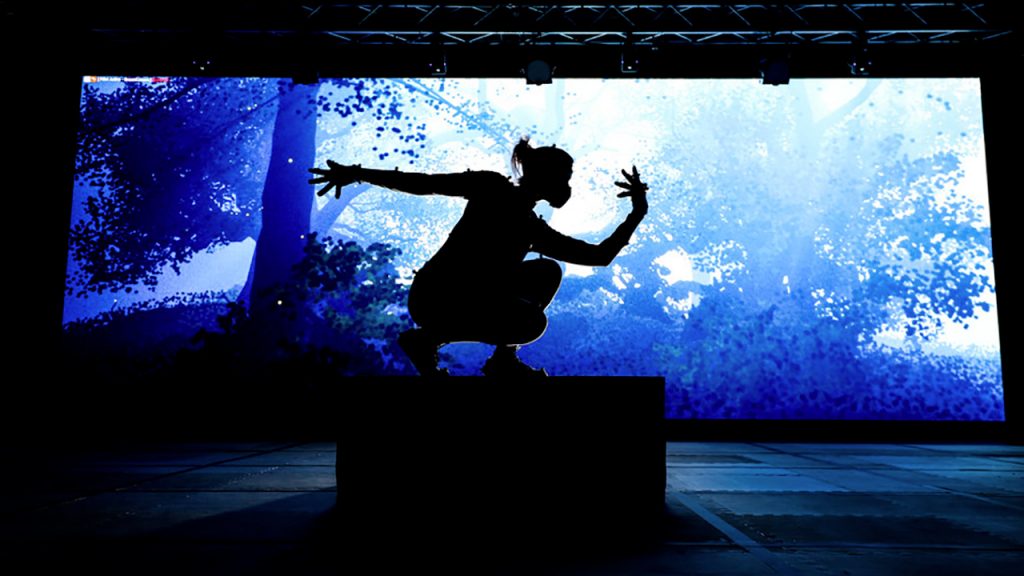
S. E. – We’ve been delighted by the fact that online streaming will allow us to find new audiences. There are a couple of reasons for how that’s happened. I think the artistic of collaboration between the RSC, Marshmallow, Manchester International Festival and Nick Cave (who just joined the team, as the voice of The Voice of the Forest). It’s a delightful thing for us to have him onboard and has allowed different audiences to find us. I’m really excited about how audiences find a performance through their own community. The other part of why new audiences are coming is because we’re genuinely premiering something that’s different for all of us. It’s not business as usual for any of the artistic companies.
Looking for innovation at the Royal Shakespeare Company (RSC)
S. E. – We’ve been very fortunate in the UK to receive funding for research. That’s why I feel very personally that we should share that research with our community. It is a community-building exercise, and that community knows what risk you take as well. For the last 10 years we tried things, we built a series of works that have looked at the future of performance. In 2016 the RSC collaborated with The Imaginarium Studio on THE TEMPEST – using real time motion-capture to create an avatar (link). We already work with MIDSUMMER NIGHT’S DREAM with Google in 2013 (link). That was a moment where we reached 30 million people on social media. What do you do with that? It’s not that we take every technology and somehow shoehorn it in. It’s about what the R&D allows us to do as an experiment with technology, to see what we might like to take forward and what works. Always, always at the heart of what we do is looking at what the promise of theatre is.
S. E. – (DREAM) is just such a wonderful play to innovate with. It’s got so much in it. We are on this performance taking in the fairy world and the forest in the natural environment. And that’s what we will focus on. The play talks about humanity, about the world in flux. It is really confused by the behaviour of the human world. And I think in a pandemic, it may be one of the most brilliant titles for us to use to reimagine, rebuild and repair maybe what we’ve lost. We’re making the play for the time we’re in now. And maybe we might be able to take some of those audiences and communities forward as we come through the pandemic – with maybe a positive thing from a very, very difficult time.
DREAM at SXSW
S. E. – We really are delighted to be part of the SXSW and to reach that global audience. We program times that work for East Coast, West Coast in the US and then Asia Pacific. We’re kind of touring! It’s lovely to be part of this festival, to be able to touch as many homes as possible. After that and the scheduled performances we’ll see where we are and if it might have a future life – which will be exciting. Our next job is to get the learnings out. How to use this project potentially to get a wider reach? How can we get the communities’ work understood and shared more broadly?